Touch
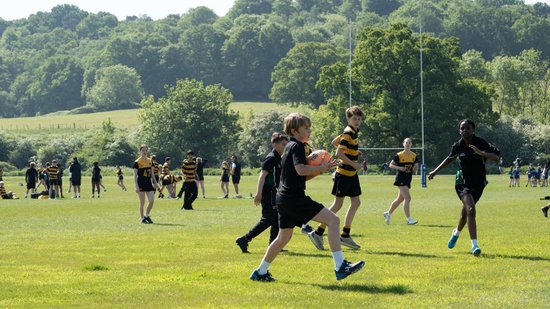
What is Touch?
Touch is a popular, fast-paced, non-contact version of rugby that replaces tackles with a touch of the hand and focuses on speed, agility and ball-handling skills. Touch is usually played 6-a-side and on a space equivalent to half a standard rugby pitch. There are often up to 14 players per team, and players can constantly interchange (sub) throughout games.
The aim of the game is simple: to score tries on or over the try line without being touched by a defender. This promotes running into space, passing into space or 'taking a touch' to create space by requiring the defenders to move back 'onside' after the touch to give the attacking team space to 'play the ball'.
Attacking teams receive six touches to score a try; if no try is forthcoming after the sixth touch, possession of the ball is turned over to the opposition to have a go. Changeovers in possession happen frequently, but the game does not stop, which increases both skills acquisition and cardiovascular fitness. Defenders must work together as a team and communicate frequently to ensure they defend space so that attackers are not able to run through gaps in between them and score tries.
Touch can be played indoors, outdoors, on any surface and in any space available – with minor modifications to playing numbers and rules to facilitate young people’s engagement and enjoyment of games.
Primary formats
These Touch formats for primary school games make the traditional game simpler so that more children can join in, feel included, and stay engaged.
The Touch Activity Festival Games enable young people focus on one skill or rule at a time in a simple, fun setting. These games help them build important skills and understand the game at a slower pace than in regular matches. This way, they can practice each skill and rule before moving on to the next.
Help young people to put into practice the skills and rules they have developed in the Touch Activity Festival Games - in a larger game which has a slightly more competitive element. The format of Super 6s can be adapted to the learning needs of the participants, and rules/skills can be progressed or regressed as necessary throughout games. There are also ‘Super Powers’ that teachers and young leaders can use to ensure everyone (especially those with SEND) is included and engaged in games.
The Touch Schools Festival Format is for Years 5 and 6 once they have developed skills and game understanding from the Touch Activity Festival and Super 6s. This format enables young people to experience the game which is played at community clubs with the inclusion of the ability to replay any skills or rule 'errors'; possession of the ball is not lost until after the sixth touch has occurred, thereby giving young people multiple opportunities to get an 'action replay' and experience more 'success' within games thereby building confidence and resilience.
Secondary formats
The Touch formats for School Games at secondary schools are not vastly different to the primary school formats, as many young people have not had the opportunity to play rugby-based games in primary school or within their community settings, so the Touch Activity Festival Games support the development of key skills and concepts within rugby-based games.
From there, young people can progress to Super 6s – bringing together all the skills and game understanding in a more competitive setting, with rules adapted to secondary school age, while the Super Powers remain available to support inclusion and engagement for all participants.
The Touch Schools Festival format allows young people to experience a format similar to that offered in community club settings, with adaptations to support skills development, game understanding, and participant engagement. The game can be played in its simplest format, with opportunities to replay any skills or rule 'errors' (to build confidence and resilience) before bringing in more skills and rules closer to the community game when skills competency and game understanding improve, and the participants require more challenge to enhance enjoyment.
SEND formats
Adaptations for SEND are interwoven in the Touch formats for primary and secondary School Games rather than sitting in a standalone format, so that teachers and young leaders can adapt the game as required to facilitate inclusion and engagement for young people with SEND.
'How to make it more inclusive' has been added to each game within the formats, as well as a range of 'Super Powers' that can be used to increase the engagement of all participants. In making the formats more accessible for those with SEND, everyone can be included without the need to have separate areas or separate games.
Equipment needed
- Balls – ideally size 3 or 4 rugby balls or any ball (foam balls are great for those new to catching/passing)
- Cones – to mark out to playing areas
- Bibs – to identify the different teams or roles
- Hoops – for one of the game (if available)
Visit England Touch's web shop for additional equipment.
Get involved
The School Games is inclusive to all young people and provides opportunities for everyone to get involved, either within school, against other local schools, or at county or regional level.
School Games Organisers
School Games Organisers (SGO) help schools coordinate appropriate competitive opportunities for all young people from Key Stage 2-4, to recruit, train and deploy a suitable workforce, and to support the development of club.
Sign up to find your local SGO